
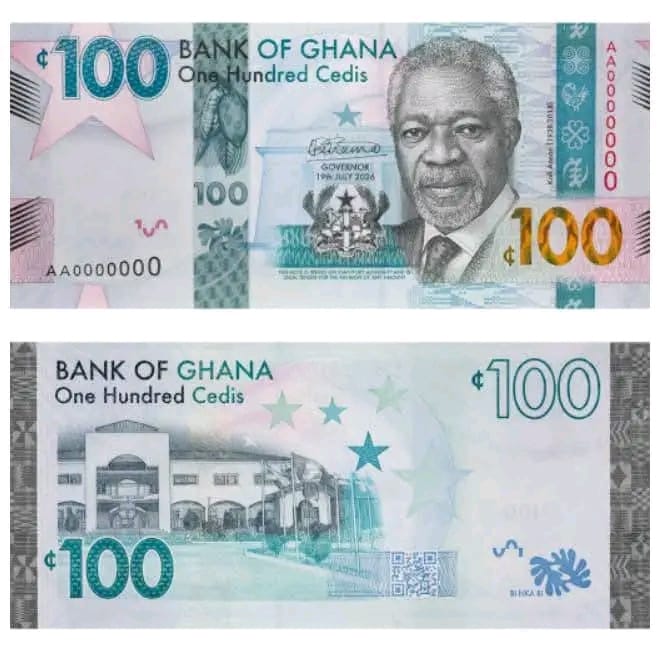
Long before his portrait was selected for Ghana’s new GH¢100 banknote, Kofi Annan was a student at the institution now known as the Kwame Nkrumah University of Science and Technology, Kumasi (KNUST).
His association with the University continued beyond his student years. On August 24, 1998, KNUST conferred an honorary Doctor of Science degree on him, recognising a former student who had risen to become United Nations Secretary-General.
Annan is one of four personalities on Ghana’s new Heritage Series banknotes whose lives connect with KNUST through education, teaching, national leadership or family. The others are Dr Kwame Nkrumah, Dr Ephraim Amu and Mrs Theodosia Salome Okoh.
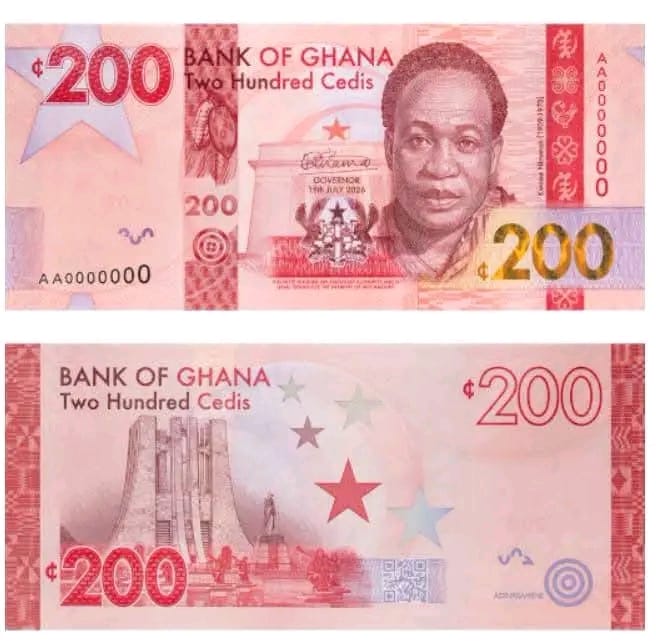
Unveiled on November 12, 2026, the series features Nkrumah on the GH¢200 note, Annan on GH¢100, Okoh on GH¢50 and Amu on GH¢20. Together, their stories offer a way of tracing parts of the University’s history through figures recognised for their contributions to Ghana.
For Annan, the connection began with his education in Kumasi. He subsequently completed his undergraduate studies in economics at Macalester College in the United States in 1961, before pursuing further studies in Geneva and at the Massachusetts Institute of Technology.
He served as UN Secretary-General from 1997 to 2006 and shared the 2001 Nobel Peace Prize with the United Nations. His honorary doctorate from KNUST added another chapter to a relationship that began before his international diplomatic career.
Nkrumah’s connection is embedded in the University’s name and development.
The Kumasi College of Technology was established by a government ordinance in October 1951 and officially opened on January 22, 1952. Its initial student population included 200 teacher training students transferred from Achimota.
Under Nkrumah’s government, the college became a full university through an Act of Parliament on August 22, 1961, taking the name Kwame Nkrumah University of Science and Technology. His portrait on the highest denomination therefore recalls a political leader whose tenure encompassed the institution’s transition from college to university.
Amu’s story leads back to the classrooms and musical activities of the early college.
The composer and music educator moved from Achimota to Kumasi when the teacher training and music programmes were transferred to the new institution. Alongside teaching, he researched Ghanaian musical traditions, bringing the study and practice of indigenous music into the college’s academic life.
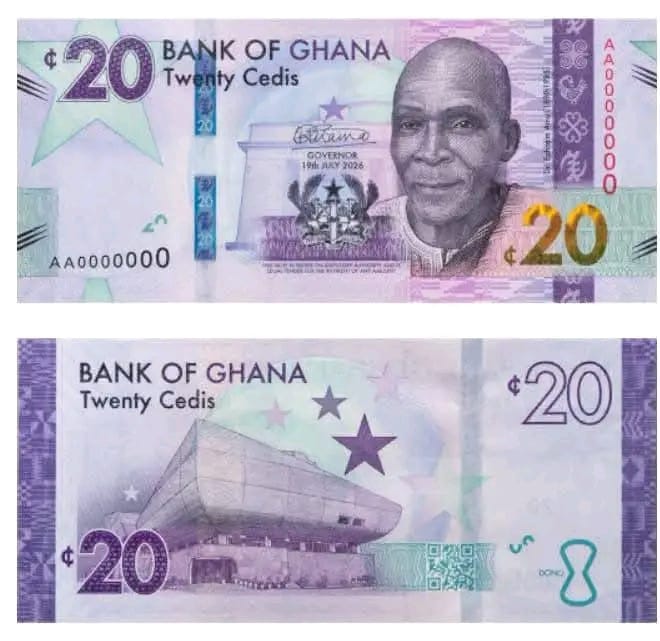
Known for the patriotic song Yɛn Ara Asaase Ni, Amu promoted African languages, instruments and musical expression throughout his career. In 1976, the University of Science and Technology, as KNUST was then named, awarded him an honorary doctorate.
His appearance on the GH¢20 note also marks a return to Ghana’s currency. His portrait previously appeared on the old 20,000-cedi banknote before the 2007 redenomination.
Theodosia Okoh’s connection to KNUST spans several generations, linking the designer of Ghana’s national flag to the University’s art history, health sciences and academic achievements.
Okoh was a sister of Professor Ernest Victor Asihene and Dr Letitia Obeng, née Asihene. Professor Asihene, an artist and scholar, served as Dean of KNUST’s College of Art and as Pro Vice-Chancellor. He also oversaw the design of the University’s emblem.
Her sister, Dr Obeng, a pioneering Ghanaian scientist, also taught at the institution that became KNUST, adding another connection between the family and the University.
Okoh’s grandnephew, Professor Yaw Adu-Sarkodie, is a clinical microbiologist and former Provost of KNUST’s College of Health Sciences. Two of her nieces also attended KNUST, one studying mathematics and the other art, both graduating with first-class honours.
Okoh’s own contribution became one of Ghana’s most recognisable national symbols. The flag she designed was first hoisted at independence on March 6, 1957. She is now honoured on Ghana’s new GH¢50 banknote.
The four feature alongside Agnes Oforiwa Tagoe-Quarcoopome on the GH¢1 note, Cardinal Peter Porekuu Dery on GH¢2, James Emmanuel Kwegyir-Aggrey on GH¢5 and Justice Annie Jiagge on GH¢10.
The Bank of Ghana says the Heritage Series will enter circulation on December 1, 2026. The new notes will circulate alongside the existing banknotes, which remain legal tender.
Story: Emmanuel Kwasi Debrah


